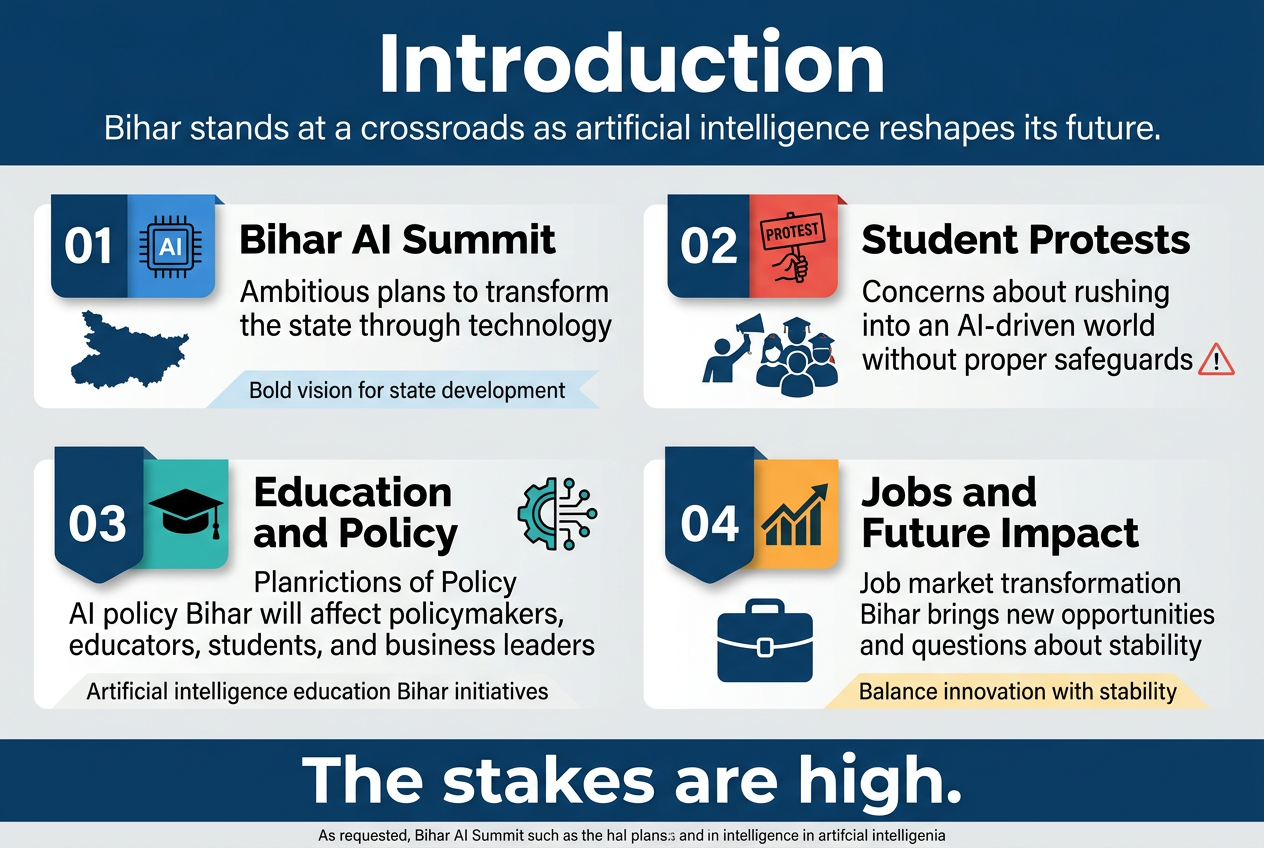
Bihar stands at a crossroads as artificial intelligence reshapes its future. The recent Bihar AI Summit showcased ambitious plans to transform the state through technology, but student protests AI Bihar reveal deep concerns about rushing into an AI-driven world without proper safeguards.
This analysis is for policymakers, educators, students, and business leaders who need to understand how AI policy Bihar will impact their communities and careers. Bihar's AI revolution promises new opportunities, yet it also raises questions about whether the state can manage such rapid change without creating chaos.
We'll examine the Bihar AI Summit's bold vision for state development and why it has sparked both excitement and controversy. You'll also learn about the growing student movement challenging AI integration challenges Bihar and what their concerns mean for the future. Finally, we'll explore how artificial intelligence education Bihar initiatives could reshape the job market transformation Bihar while examining whether the state can balance innovation with stability.
The stakes are high. Bihar's 125 million residents deserve to know if this AI revolution Bihar state will create the promised opportunities or leave communities behind.
Bihar AI Summit: Game-Changing Vision for State Development
Key announcements and AI initiatives unveiled at the summit
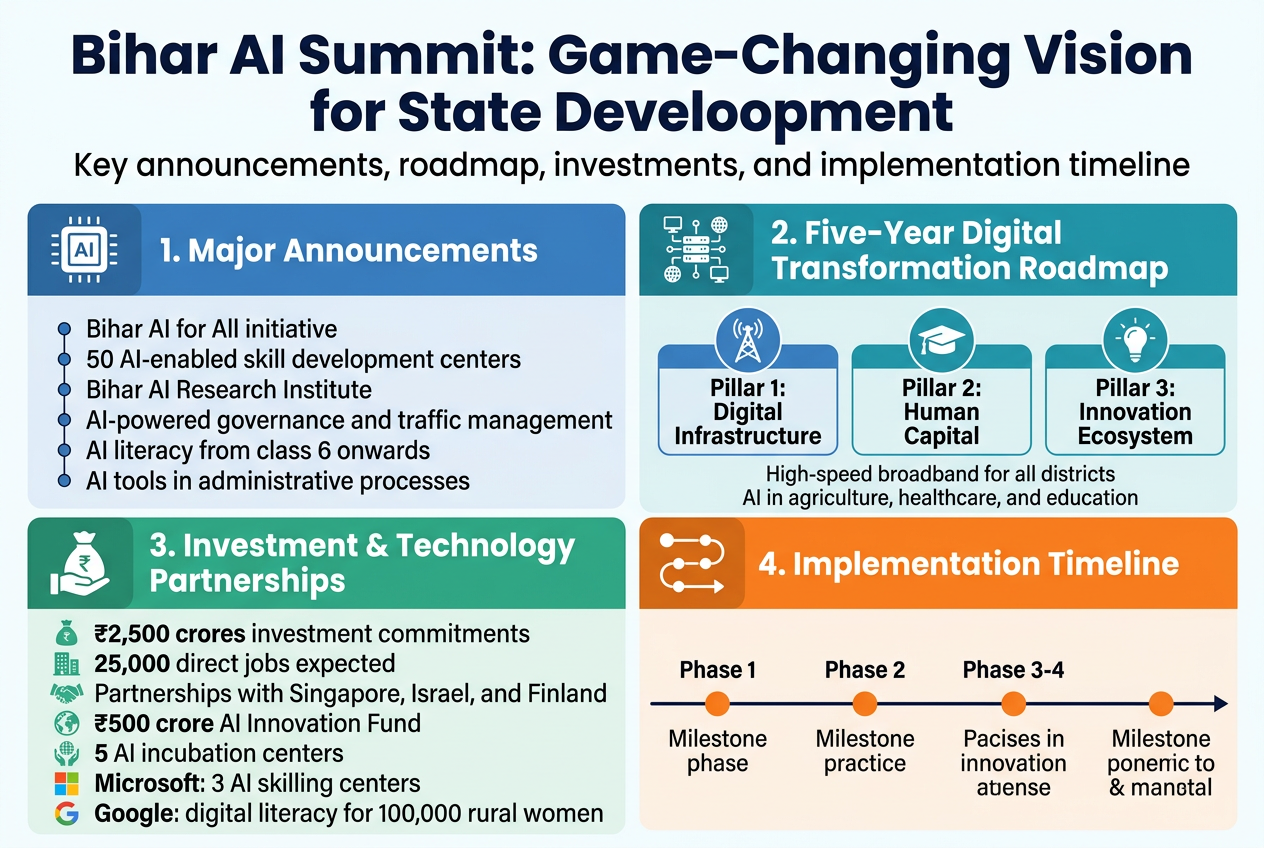
The Bihar AI Summit marked a watershed moment for the state's technological aspirations. Chief Minister Nitish Kumar announced the launch of the "Bihar AI for All" initiative, aimed at democratizing artificial intelligence access across rural and urban areas. The summit revealed plans for establishing 50 AI-enabled skill development centers throughout the state, focusing on training youth in emerging technologies.
A standout announcement was the creation of the Bihar AI Research Institute, a collaborative effort between the state government and leading technology companies. This institute will serve as the nerve center for AI innovation, research, and development tailored to local challenges. The government also unveiled plans for AI-powered governance solutions, including automated public service delivery systems and intelligent traffic management for major cities like Patna and Gaya.
The educational sector received significant attention with the introduction of AI literacy programs for students from class 6 onwards. The summit also announced the integration of AI tools in administrative processes, promising to reduce bureaucratic delays and improve service delivery across government departments.
Government's strategic roadmap for digital transformation
Bihar's digital transformation roadmap spans five years, with AI serving as the cornerstone of modernization efforts. The strategy focuses on three core pillars: digital infrastructure development, human capital enhancement, and innovation ecosystem creation.
The first phase involves upgrading internet connectivity across all districts, ensuring high-speed broadband reaches remote villages. This foundation supports the second phase, which introduces AI applications in agriculture, healthcare, and education. Farmers will benefit from AI-driven crop monitoring systems, while healthcare facilities will implement diagnostic AI tools to improve medical outcomes in underserved areas.
The government outlined specific sector-wise implementation plans. Agriculture will see AI-powered weather prediction systems and smart irrigation solutions by 2025. Healthcare infrastructure will incorporate telemedicine platforms enhanced with AI diagnostic capabilities. Educational institutions will adopt personalized learning systems that adapt to individual student needs and learning patterns.
Public administration transformation includes digitizing land records, implementing AI-based grievance redressal systems, and creating predictive analytics for policy planning. The roadmap emphasizes creating a skilled workforce capable of managing and maintaining these AI systems, ensuring sustainable long-term growth.
Investment commitments and technology partnerships established
The Bihar AI Summit attracted significant investment commitments totaling ₹2,500 crores from various technology companies and venture capital firms. Major players including Tata Consultancy Services, Infosys, and several Silicon Valley startups announced plans to establish operations in Bihar, creating an estimated 25,000 direct jobs over the next three years.
International partnerships emerged as a key highlight, with agreements signed between Bihar and technology hubs in Singapore, Israel, and Finland. These partnerships focus on knowledge transfer, joint research projects, and establishing Bihar as a regional AI hub for eastern India. The Finland collaboration specifically targets AI applications in education, leveraging their world-renowned educational technology expertise.
Local entrepreneurs and startups received boost through the announcement of a ₹500 crore AI Innovation Fund. This fund will provide seed capital and mentorship support to Bihar-based startups working on AI solutions for agriculture, healthcare, and governance challenges. The government also committed to creating AI incubation centers in five major cities, providing infrastructure and support for emerging technology companies.
Corporate giants pledged to establish training centers, with Microsoft announcing plans for three AI skilling centers and Google committing to digital literacy programs reaching 100,000 rural women within two years.
Timeline for implementing AI across government sectors
The implementation timeline follows a carefully phased approach designed to ensure smooth adoption across government sectors. Phase One, running from 2024 to 2025, focuses on foundational infrastructure and pilot programs in select districts. This includes deploying AI systems in urban local bodies, digitizing government records, and launching AI-powered citizen service portals.
Phase Two, spanning 2025 to 2026, expands AI implementation to all districts with emphasis on revenue, police, and healthcare departments. The police department will implement facial recognition systems and predictive policing tools, while revenue offices will use AI for land record verification and property assessment. Healthcare facilities will begin using AI diagnostic tools and patient management systems.
Phase Three, scheduled for 2026 to 2027, represents full-scale deployment across all government departments. This includes AI-powered recruitment systems, automated compliance monitoring, and intelligent budget allocation tools. The education department will complete its AI integration with personalized learning platforms operational in all government schools.
The final phase involves optimization and advanced AI applications, including predictive governance models and citizen behavior analytics for better policy formulation. Regular monitoring and evaluation mechanisms ensure each phase meets its targets before progressing to the next level, with built-in flexibility to address emerging challenges and opportunities.
Student Protests: Voices of Concern Over AI Integration
Primary grievances and demands raised by protesting students
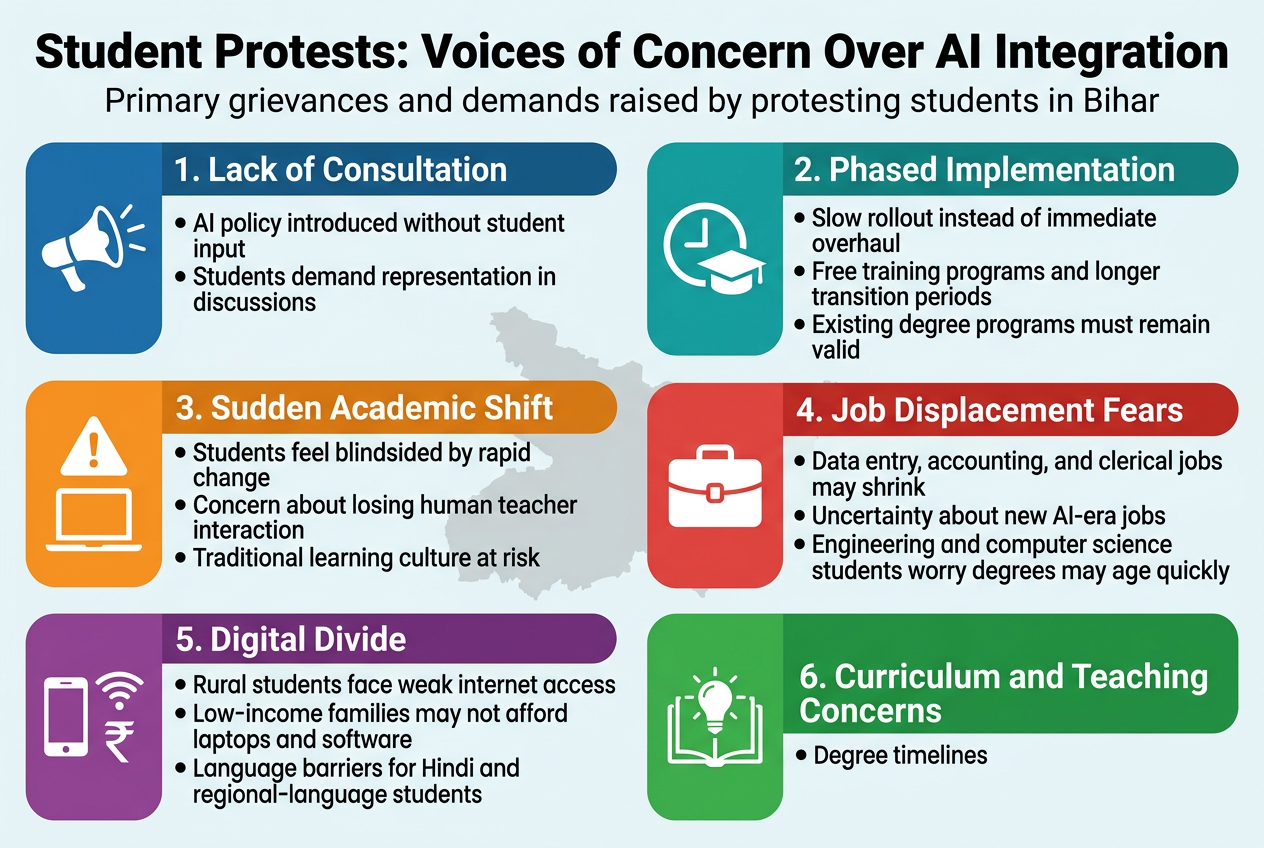
Students across Bihar have voiced sharp opposition to the rapid AI integration proposed at the Bihar AI Summit, presenting a unified front with specific demands. Their primary grievance centers on the lack of consultation before implementing AI policy Bihar initiatives. Student unions argue that educational institutions rushed into artificial intelligence education Bihar programs without adequate preparation or student input.
The protesters demand a phased implementation approach rather than the immediate overhaul suggested by policymakers. They want guaranteed support systems, including free training programs and extended transition periods for students already enrolled in traditional courses. Many students specifically request that existing degree programs remain valid and that AI integration doesn't render their current studies obsolete.
Student organizations have also called for transparent communication about how AI will affect their academic pathways and career prospects. They insist on having student representatives involved in AI policy discussions, citing the need for grassroots input in decisions that directly impact their futures.
Resistance to sudden technological shifts in academia
The student protests AI Bihar movement reflects deep-seated anxiety about abrupt changes in educational methodology. Many students feel blindsided by the speed at which institutions plan to incorporate AI tools into their daily learning experience. Traditional learners, particularly those from rural backgrounds, express frustration with the assumption that everyone can quickly adapt to new technologies.
Academic departments face student pushback against replacing established teaching methods with AI-driven alternatives. Students worry that professors might rely too heavily on automated systems, potentially reducing meaningful human interaction in the learning process. This resistance isn't just about technology itself but about preserving the educational culture they value.
Fear of job displacement in traditional employment sectors
Employment concerns drive much of the student unrest surrounding Bihar's AI revolution. Students pursuing degrees in fields like data entry, basic accounting, and clerical work worry that AI automation will eliminate entry-level positions before they graduate. The job market transformation Bihar promises doesn't offer immediate reassurance for those expecting traditional career paths.
Many students come from families where government jobs and established private sector roles provided economic stability for generations. The shift toward AI-related employment opportunities AI Bihar creates uncertainty about whether these new positions will offer similar security and benefits. Students fear that without proper preparation, they'll find themselves competing for fewer traditional jobs while lacking skills for emerging AI-driven roles.
Engineering and computer science students express particular anxiety about AI potentially making their specialized knowledge less valuable. They worry that rapid technological advancement might outpace their learning, making their degrees less relevant by graduation time.
Political dimensions and government response strategies
The Bihar government faces mounting pressure to address student concerns while maintaining its AI development agenda. Political parties have begun taking sides, with opposition groups supporting student demands for slower implementation and ruling party members defending the AI integration timeline.
Student protests have forced the government to reconsider its communication strategy around AI policy Bihar initiatives. Officials now hold regular town halls and campus visits to explain how AI integration challenges Bihar will be managed. The administration has also established grievance committees specifically for addressing student concerns about technological transitions.
Political observers note that student unrest could influence upcoming elections if not handled carefully. The government's response strategy now includes targeted scholarship programs and guaranteed job placement assistance for students affected by AI-related curriculum changes.
Concerns about digital divide and access inequality
Rural students particularly worry about the digital divide widening as AI becomes central to education. Many come from areas with unreliable internet connectivity and limited access to modern technology. They fear that AI-heavy curricula will disadvantage them compared to urban students who grow up with better technological resources.
Economic disparities also fuel concerns about access inequality. Students from low-income families worry they cannot afford the laptops, software, and internet plans necessary for AI-integrated education. This creates anxiety about being left behind in an increasingly technology-dependent academic environment.
Language barriers add another layer of concern, as many AI tools and resources primarily operate in English, potentially disadvantaging students more comfortable with Hindi or regional languages.
Impact on existing educational curriculum and teaching methods
Current students express frustration about curriculum changes affecting their degree completion timeline. Many worry that shifting requirements might force them to take additional courses or extend their studies, creating financial strain on their families.
Teachers and students alike struggle with the pace of change in teaching methods. Faculty members who spent years mastering traditional pedagogical approaches now face pressure to incorporate AI tools they may not fully understand. This creates a trickle-down effect where student learning suffers during the transition period.
Students also question whether AI integration will compromise the critical thinking skills that traditional education emphasizes. They worry that over-reliance on automated systems might reduce their ability to solve problems independently or think creatively about complex issues.
AI Policy Framework: Reshaping Bihar's Educational Landscape
New Skill Development Programs Aligned with AI Technologies
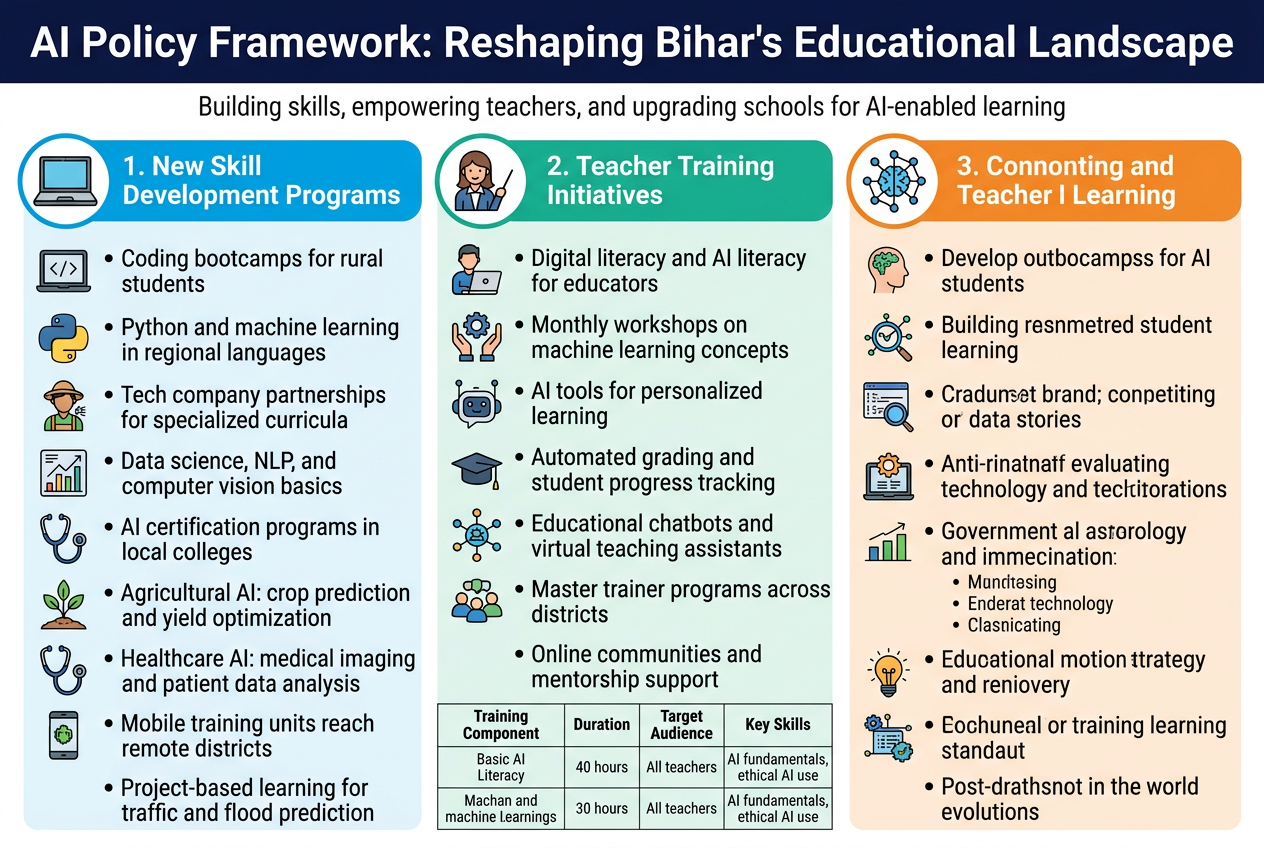
Bihar's AI policy framework introduces comprehensive skill development programs designed to prepare students for the digital economy. These programs focus on coding bootcamps specifically tailored for rural students, offering intensive Python and machine learning courses in regional languages. The state has partnered with leading tech companies to create specialized curricula covering data science fundamentals, natural language processing applications, and computer vision basics.
Local colleges now offer AI certification programs that bridge traditional academic subjects with practical artificial intelligence applications. Students can pursue specialized tracks in agricultural AI, helping them develop solutions for crop prediction and yield optimization. Healthcare-focused AI modules teach students to work with medical imaging systems and patient data analysis tools.
The Bihar AI development initiative includes mobile training units that travel to remote districts, ensuring equitable access to AI education regardless of geographic location. These programs emphasize hands-on learning through project-based assignments where students create AI solutions for local community problems, from traffic management systems to flood prediction models.
Teacher Training Initiatives for Digital Literacy Enhancement
The artificial intelligence education Bihar strategy recognizes that educator preparedness drives successful AI integration. Comprehensive teacher training programs now equip instructors with essential digital skills and AI literacy. Monthly workshops help teachers understand machine learning concepts, enabling them to explain complex AI principles in simple, relatable terms to their students.
Professional development sessions focus on practical AI tools that teachers can immediately implement in their classrooms. Educators learn to use AI-powered platforms for personalized learning, automated grading systems, and student progress tracking. The training includes hands-on experience with educational chatbots and virtual teaching assistants.
Master trainer programs create a network of AI-savvy educators who can train their peers across different districts. These programs emphasize pedagogical approaches for teaching AI concepts without requiring advanced technical backgrounds. Teachers receive ongoing support through online communities and mentorship programs.
| Training Component | Duration | Target Audience | Key Skills |
|---|---|---|---|
| Basic AI Literacy | 40 hours | All teachers | AI fundamentals, ethical AI use |
| Advanced Integration | 80 hours | STEM teachers | Programming basics, AI tools |
| Leadership Training | 60 hours | Department heads | Policy implementation, change management |
Infrastructure Upgrades Required for AI-Enabled Classrooms
Bihar's educational technology transformation demands substantial infrastructure investments to support AI-enabled learning environments. Schools need high-speed internet connectivity, with fiber optic networks reaching even remote village schools. The state plans to establish smart classrooms equipped with interactive whiteboards, tablets for every student, and cloud-based learning management systems.
Power infrastructure remains a critical challenge, requiring solar panel installations and backup battery systems to ensure uninterrupted digital learning. Computer labs need upgrades with modern hardware capable of running AI software and simulation tools. The AI integration challenges Bihar faces include establishing reliable technical support networks in rural areas.
School buildings require structural modifications to accommodate new technology infrastructure, including proper ventilation for server rooms and secure storage for expensive equipment. The state invests in creating maker spaces where students can experiment with robotics, IoT devices, and AI hardware components.
Network security infrastructure becomes essential as schools connect to the internet and use cloud-based AI platforms. Schools need robust cybersecurity measures to protect student data and ensure safe online learning environments. Regular maintenance contracts with technology vendors ensure equipment remains functional and updated with the latest AI capabilities.
Employment Revolution: Job Market Transformation in Bihar
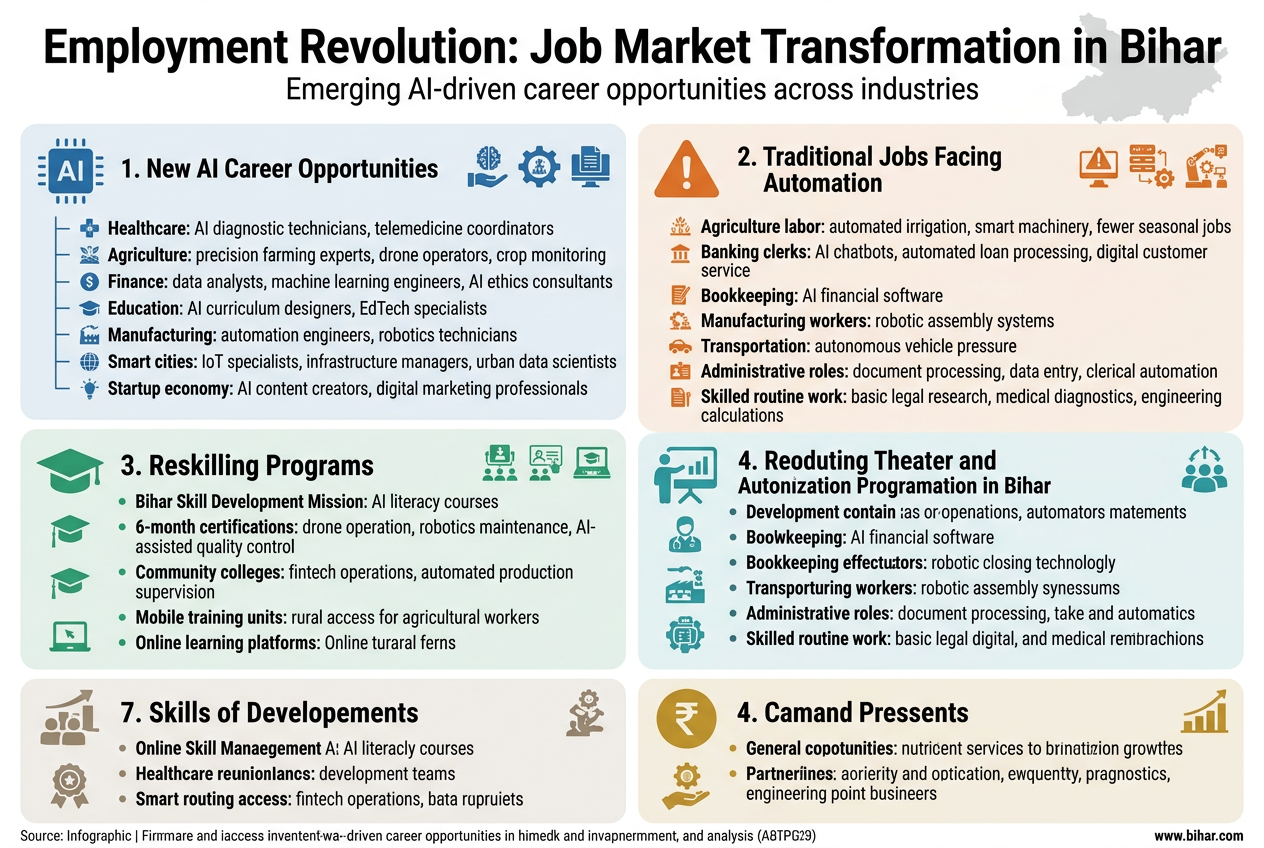
Emerging AI-driven career opportunities across industries
The job market transformation Bihar is creating unprecedented opportunities across multiple sectors. Healthcare technology specialists are now in high demand, with positions like AI diagnostic technicians and telemedicine coordinators emerging in Bihar's expanding medical facilities. The agriculture sector, which employs over 75% of Bihar's population, desperately needs precision farming experts who can deploy drone technology and AI-powered crop monitoring systems.
Financial technology roles are exploding as Bihar embraces digital banking and fintech solutions. Data analysts, machine learning engineers, and AI ethics consultants represent completely new career paths that didn't exist five years ago. Educational institutions are seeking AI curriculum designers and EdTech specialists to modernize learning experiences across the state.
The manufacturing sector, particularly in food processing and textiles, requires automation engineers and robotics technicians. Smart city initiatives in Patna and other urban centers are creating demand for IoT specialists, smart infrastructure managers, and urban data scientists. Content creators specializing in AI tools and digital marketing professionals using AI-powered analytics tools are finding lucrative opportunities in Bihar's growing startup ecosystem.
Traditional job sectors facing automation challenges
Bihar's traditional employment landscape faces significant disruption as artificial intelligence education Bihar initiatives accelerate automation adoption. Agricultural labor, which forms the backbone of rural employment, confronts challenges from AI-powered farming equipment and automated irrigation systems. Small-scale farmers worry about reduced demand for seasonal workers as smart machinery handles planting, harvesting, and crop monitoring tasks.
The banking sector in Bihar has already witnessed substantial automation impact. Teller positions, loan processing clerks, and basic customer service roles are increasingly handled by AI chatbots and automated systems. Traditional bookkeeping and accounting jobs in small businesses face pressure from AI-powered financial software that can process transactions and generate reports automatically.
Manufacturing units across Bihar, particularly in the textile and food processing industries, are replacing assembly line workers with robotic systems. Transportation jobs face long-term threats from autonomous vehicle development, though this transition remains gradual in Bihar's current infrastructure context.
Administrative positions in government offices and private companies are experiencing automation pressure as document processing, data entry, and routine clerical tasks become automated. Even skilled professions like basic legal research, routine medical diagnostics, and standard engineering calculations now compete with AI systems.
Reskilling programs to bridge the employment transition gap
Bihar's government has launched comprehensive reskilling initiatives to address employment opportunities AI Bihar challenges. The Bihar Skill Development Mission now offers AI literacy courses in partnership with major technology companies, targeting displaced workers from traditional industries. These programs focus on practical skills like operating AI-powered agricultural equipment, basic data analysis, and digital customer service management.
Technical training institutes across the state have introduced short-term certification programs in emerging technologies. Workers from declining sectors can access six-month courses in areas like drone operation for agriculture, basic robotics maintenance, and AI-assisted quality control processes. The programs deliberately avoid complex programming, focusing instead on operational skills that build on existing worker experience.
Community colleges in Bihar have partnered with private companies to create industry-specific reskilling tracks. Former bank clerks learn financial technology operations, while displaced manufacturing workers train on automated production line supervision. Mobile training units reach rural areas, ensuring agricultural workers can access AI-related skill development without relocating to urban centers.
Online learning platforms subsidized by the state government offer flexible scheduling for working adults. These digital programs allow traditional workers to upgrade their skills gradually while maintaining current employment, reducing financial stress during the transition period.
Startup ecosystem development through AI innovation
The Bihar AI development landscape has sparked an impressive startup revolution across the state. Young entrepreneurs are leveraging artificial intelligence to solve local problems while creating employment opportunities. Agricultural technology startups are developing AI-powered solutions for crop disease detection, soil analysis, and market price prediction, directly addressing Bihar's farming challenges.
Educational technology companies are emerging from Bihar's universities, creating AI-driven learning platforms customized for local languages and cultural contexts. These startups are hiring local talent while developing products that serve both Bihar's educational needs and national markets. Healthcare startups are using AI for rural telemedicine, medical record digitization, and diagnostic support systems tailored for resource-constrained environments.
Fintech startups are building AI-powered microfinance platforms and digital payment solutions designed for Bihar's largely unbanked population. These companies are creating jobs for local developers, customer service representatives, and field agents while improving financial inclusion across the state.
Government support through incubation centers and startup funding schemes has accelerated this ecosystem growth. The Bihar Innovation Hub provides mentorship, funding access, and networking opportunities for AI-focused startups. Co-working spaces in major cities offer affordable infrastructure for emerging technology companies.
Government job creation through technology adoption
Bihar's public sector is actively creating new employment categories through AI integration challenges Bihar initiatives. The state government has established dedicated positions for AI policy implementation, digital governance specialists, and technology project coordinators across various departments. These roles require understanding both government operations and modern technology applications.
Smart city projects in Bihar are generating government jobs in urban planning technology, traffic management systems, and public service digitization. Municipal corporations are hiring data analysts, smart infrastructure coordinators, and citizen engagement specialists who can manage AI-powered public service platforms.
Educational departments are creating positions for technology integration specialists, digital learning coordinators, and AI curriculum advisors. These roles help traditional educators adapt to technology-enhanced teaching methods while maintaining educational quality standards.
Healthcare administration is expanding with positions like telemedicine coordinators, health data analysts, and AI diagnostic support specialists. These government jobs bridge the gap between traditional healthcare delivery and modern technology applications, ensuring rural populations can access advanced medical services.
Agricultural extension services are hiring precision farming advisors, drone operation specialists, and AI-powered crop monitoring coordinators. These positions help farmers adopt new technologies while maintaining the government's rural development objectives.
Balancing Progress and Stability: Managing the AI Transition
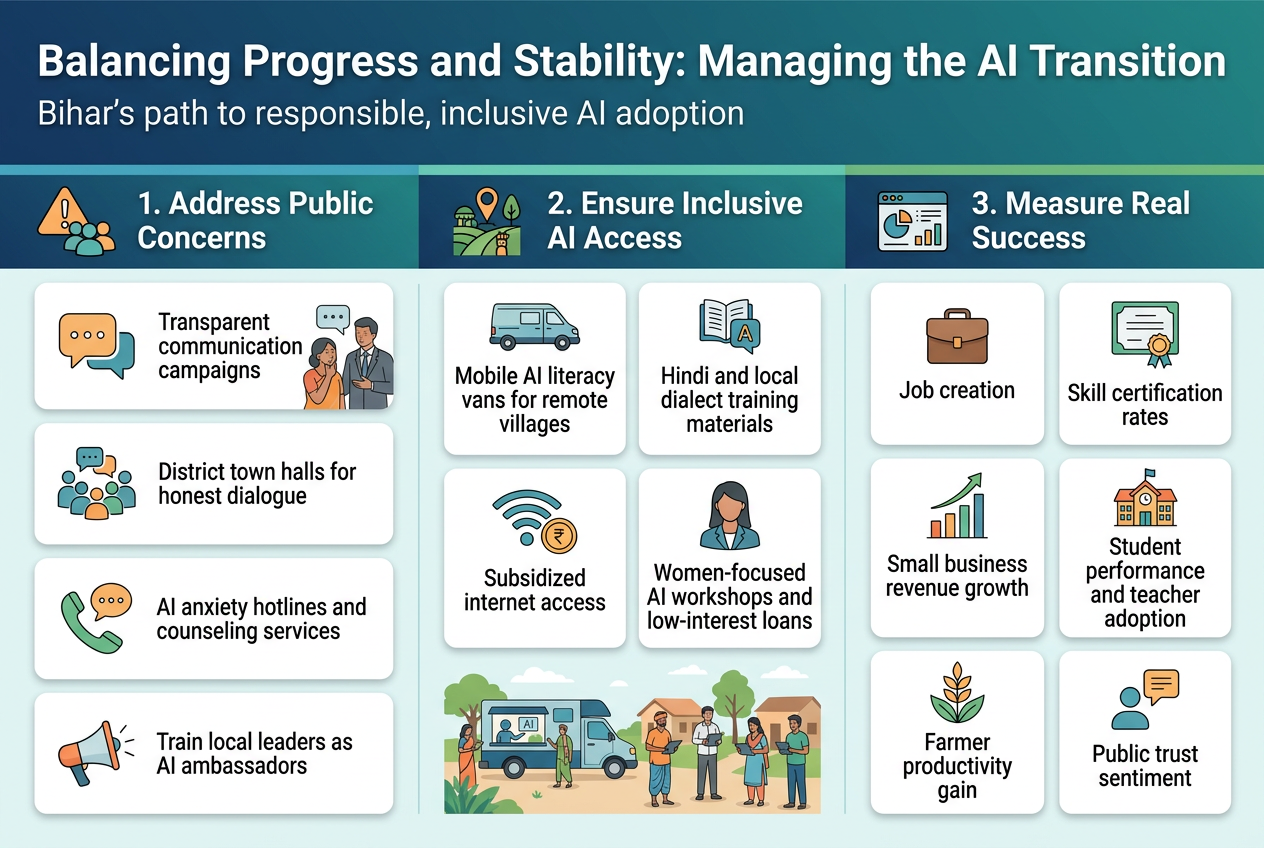
Strategies to address public concerns and resistance
Bihar's AI revolution faces real pushback from communities worried about job displacement and technology gaps. The state government needs to roll out transparent communication campaigns that explain AI benefits without sugarcoating the challenges. Town halls in every district can bring officials face-to-face with concerned citizens, creating space for honest dialogue about AI policy Bihar initiatives.
Smart change management starts with addressing the elephant in the room - fear. When students protest artificial intelligence education Bihar programs, they're not anti-progress; they're scared about their future. The government should establish AI anxiety hotlines and counseling services, helping people process these concerns constructively.
Local leaders and influencers play huge roles in shaping public opinion. Training them as AI ambassadors can help spread accurate information and counter misinformation. Community workshops demonstrating practical AI applications - like using AI tools for farming or small business management - can shift perspectives from abstract fear to concrete understanding.
Ensuring inclusive growth through equitable AI access
The Bihar AI Summit highlighted a critical gap: AI benefits can't be limited to urban tech hubs. Rural areas need equal access to AI training and infrastructure. Mobile AI literacy vans can reach remote villages, bringing hands-on training directly to farming communities and small business owners.
Language barriers remain massive roadblocks. AI education materials must be available in Hindi and local dialects, not just English. Creating AI interfaces and training content in vernacular languages ensures nobody gets left behind in the digital transformation.
| Access Strategy | Target Group | Implementation Method |
|---|---|---|
| Mobile Training Units | Rural Communities | Door-to-door AI literacy programs |
| Regional Language Content | Local Businesses | Translated training materials |
| Subsidized Internet Access | Low-income Families | Government-sponsored connectivity |
| Women-focused Programs | Female Entrepreneurs | Gender-specific AI workshops |
Financial inclusion matters too. Subsidized AI training programs and low-interest loans for AI-powered business upgrades can level the playing field. Women entrepreneurs deserve special attention - dedicated programs can help them leverage AI for home-based businesses and agricultural ventures.
Measuring success metrics for AI implementation
Success metrics for Bihar AI development need to go beyond flashy tech statistics. Real progress shows up in employment opportunities AI Bihar creates, not just the number of AI startups launched. Monthly job creation data, skill certification rates, and small business revenue increases tell the true story.
Education transformation requires granular tracking. Student performance improvements, teacher adoption rates, and parent satisfaction surveys provide meaningful insights into artificial intelligence education Bihar programs. School dropout rates and college enrollment changes reveal whether AI integration challenges Bihar communities face are being addressed effectively.
Economic impact measurements should include:
New business registrations using AI tools
Agricultural productivity increases through AI adoption
Healthcare service delivery improvements
Government service efficiency gains
Social impact tracking matters equally. Survey data on public AI acceptance, digital divide reduction metrics, and community participation rates in AI programs show whether the revolution truly serves everyone. Regular feedback loops with protest groups and community leaders help course-correct when policies miss the mark.
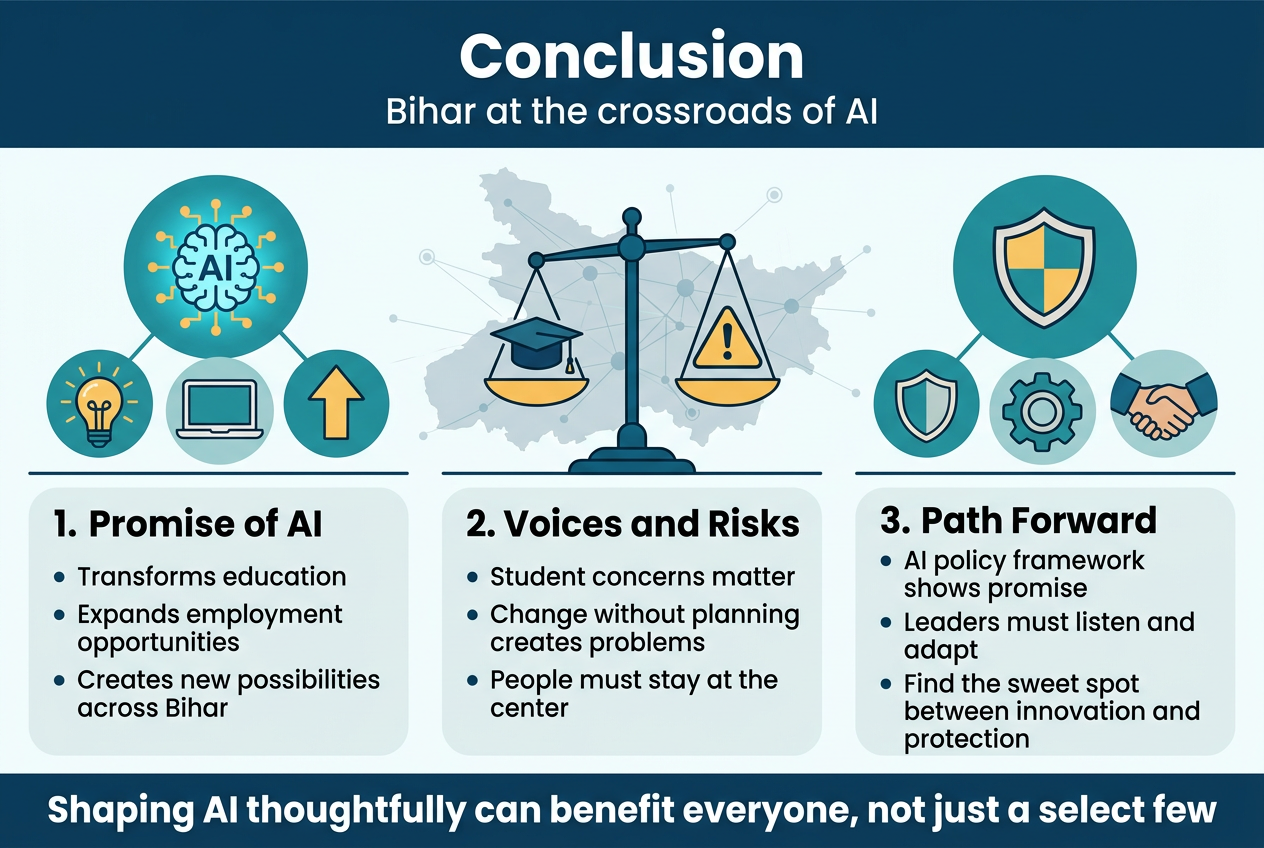
Bihar stands at a crossroads where artificial intelligence promises to transform everything from education to employment. The recent AI Summit painted a picture of incredible possibilities, while student voices remind us that change without proper planning can create real problems for real people. The state's AI policy framework shows promise, but success depends on how well leaders listen to concerns and adapt their approach.
The path forward requires finding the sweet spot between embracing innovation and protecting people during this transition. Bihar has a chance to become a model for how states can harness AI's power while keeping communities at the center of decision-making. The question isn't whether AI will change Bihar – it's whether the state will shape that change thoughtfully enough to benefit everyone, not just a select few.